
The Fedora
A Crowning Glory

There was a time when, in public, everyone would be adorned with a hat. It was unthinkable to be seen without a hat. Neither men nor women would venture out without the most defining of all accessories.
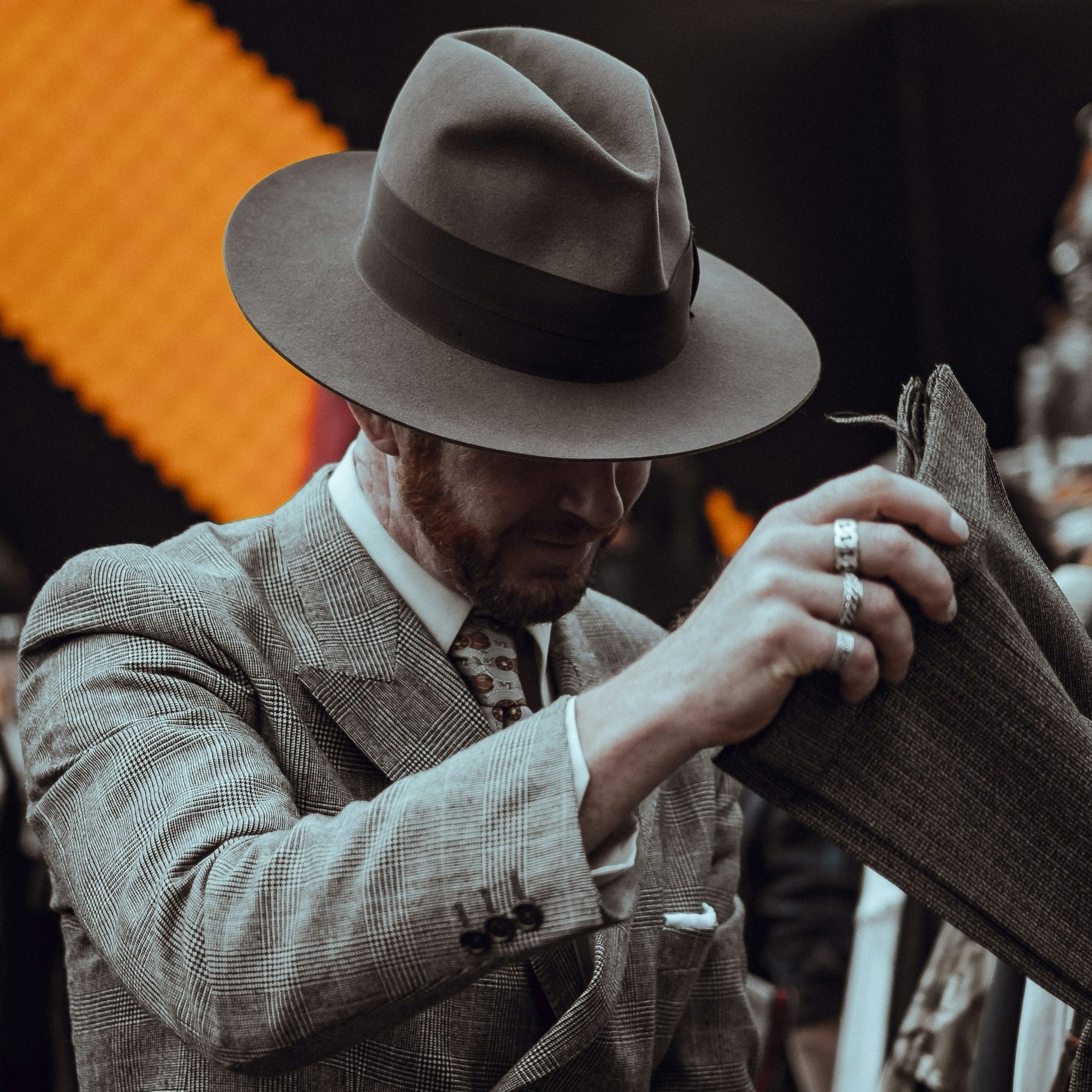
The hat is not only practical, in that it assists in keeping one warm and dry, but more importantly, perhaps it confers the status of the wearer or, in some cases, their occupation.
For both men and women there was a clear hierarchy where hats were concerned. In the case of men, the top hat was for aristocrats or gentlemen of distinction whilst the bowler was worn by the working classes before being adopted by city workers as a practical alternative to the top hat. Even within the top hat style, there was a sub hierarchy determined by the height of the hat, whereby the taller the hat the greater the distinction of the wearer.
Women’s hats were equally hierarchical. Quality of materials and decorations as well as size, conferred status and social standing, with the upper classes wearing hats as large as 24” in diameter in luxurious fabrics such as velvet with exquisite feather decorations whilst the middle classes would wear smaller versions of those worn by the elite.
How the hat was worn was also a mark of style and sophistication. Edwardian ladies would wear large hats slanted so as to frame the face in profile thereby accentuating their elegance.
Then, as is often the way in life, something occurs that ends up having a profound influence on the direction of fashion - an influence that lasted for many years and is thankfully still alive today, if only just.
In 1882, the French actress Sarah Bernhardt was playing the part of Princess Fédora Romazoff in the play Fédora in which she wore a felt hat with a pinched crown and a wide brim. It rapidly grew as a women’s fashion accessory taking its name from the play by Victorien Sardou.
Whether the hat worn by Sarah Bernhardt was exactly what we would today recognise as a Fedora is not known, being described at the time as a soft brimmed hat. Popular in the late 19th Century with women’s rights activists, it is today considered more of a man’s fashion accessory. Its popularity with men gained traction in the 1920s and reached its peak between the 1930s and 1950s. It replaced the stiffer look of the bowler and Homburg and crossed all classes, being worn by royalty, professionals, detectives and gangsters alike.
To my mind, the Fedora looks stylish on both men and women. Whilst men may choose the classic colours of dark grey, black, brown or olive green, women can experiment with more exotic colours to match their overall look.
By the late 1970s both sexes had more or less abandoned hats as part of their regular wardrobe. Whilst during the 30s and 40s it was unthinkable to appear in public without a hat, the position had completely reversed by the late 70s. In fact by the late 1940s hat sales were falling both in Europe and America. To combat the decline in sales the Hatters Development Council (yes really!) came up with the slogan - “If you want to get ahead, get a hat”.
If a hat is donned today it is invariably the wretched base ball cap - a prime candidate for Room 101 if ever there was one.
To wear a classic hat today requires determination, bravery and a sense of style. It must be worn with confidence, for the very act of wearing one enhances authority and confidence in the wearer. Worn with style, ones deportment improves and perhaps ones manners are enhanced. Removal when entering a building or a mere touch of the brim to acknowledge a passer-by projects consideration for others.
Sadly, it is too much to hope that we will witness a return to such style. We have passed the point where people care enough about how they look to concern themselves with what they would consider to be so trivial. They overlook, however, the power and status conferred by a piece of headgear.
If you believe beauty still matters, consider becoming a subscriber.
Join a growing circle of readers who see the world through the lens of design and meaning.
Paid subscribers receive deeper reflections and private essays exploring the intersection of architecture, art and culture.
About the Author:
Nicholas Engert is the founder and creative director of Nicholas Engert Interiors, a studio known for its timeless, elegant and understated design philosophy. With decades of experience in interior architecture and design, Nicholas brings a refined eye and a wealth of knowledge to every project, blending form, function and character with a deep understanding of client needs. Every product featured in the studio’s collection is personally selected to meet exacting standards of quality, design, and aesthetic integrity.
If you enjoy these articles you may like to visit our websites -
Fourth Dimension Lighting Design
Loved this article. Most of us in southern California wear hats to teas, and possibly weddings, but they do lend a lovely look to one's outfit of the day. I have hats of my own, but also from my mother's and grandmother's wardrobes which I treasure.